In 1944 Heider and Simmel, experimental psychologists, did a landmark study at Smith College. Geometric shapes moved across the screen: a tiny triangle, a larger triangle, and a circle moved in and out of a rectangle and all over the monitor. Of the 34 young women tested, 32 of them saw these shapes as human and began to tell their story. One girl saw birds. One saw geometric shapes moving across a screen. This straightforward girl noted that they frequently bumped into one another. Most agreed that that the big triangle was a bully, “bad-tempered” and “aggressive”. The circle was deemed “shy, timid and meek” while the small triangle was believed to be “valiant, clever and shrewd”. How can it be so simple to see the story of shapes and so difficult to express a human story. Stories need to be told, need to be heard. They wait to be told and re-told. Not shapes, but flesh and blood. The story matters.
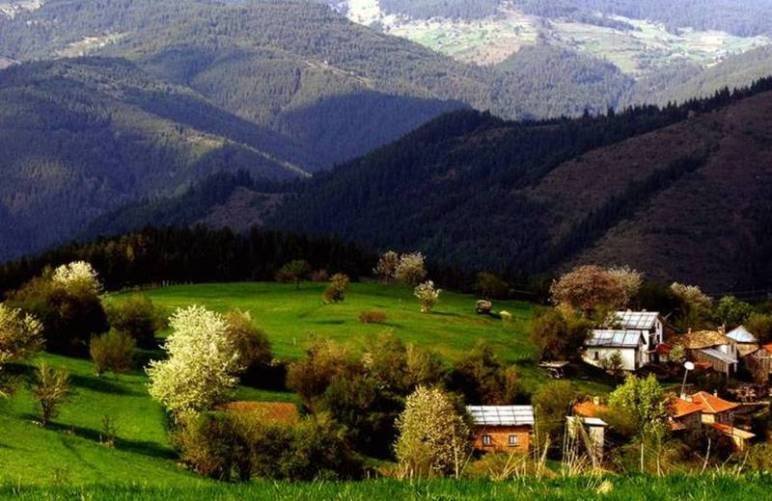
The Rhodope Mountains are considered to be the birthplace of Orpheus, the mythical poet and musician. His songs were so beautifully sung that he convinced Hades to release his wife from the Underworld. When looking at the mountains, it is not hard to believe that a hero would hail from them. Unlike many other spots on the Balkan Peninsula, the rivers here are almost always flowing and the vegetation is lush. It is a place where your soul breathes. While the mountains provide no impediment to being conquered, they do make travel and commerce difficult. The small Bulgarian village of Orehovo sits among these mountains and to this day it remains mostly untouched by modernity. Over 300 years ago when it was founded, it was constructed along the remains of an ancient Roman city built next to an even more ancient Thracian road. This sparsely inhabited area is simple, pure and home to wonders: natural bridges, caves covered in white calcite and powerful waterfalls.
The Ottomans were less aggressive and tyrannical in most areas of Bulgaria when compared to their other conquered territories: the women had more freedom, forced converts were allowed to keep their names, sometimes swine could still be raised, and they were allowed to retain their language. When Constantinople fell in 1453 it gave the Turks a foothold and base from which to crush local, Bulgarian resistance. Slowly, whole cities and regions succumbed. By 1600 the Ottomans reached the peak of their power and expanded their territorial control throughout the Balkan Peninsula. In certain places, like Orehovo the story was one of mass conversion and brutality. The shapes of the story come together to tell of suffering and a descent into a cave that was forever.
What happened in the Rhodopes? Why were they so systematically brutal? Why did they kill and pillage? What about these villages called for their destruction? All we have are the stories of the locals who remain: the lore, the legend, and the history.
The villagers heard that the Ottoman army was approaching. It was well-known throughout the village that caves had been washed out from the waters. If you were to step down to the left of Cheleveshkata Cave there was a steep and dangerous abyss. To the right there appeared to be a gradual path. Those born and raised in Orehevo knew appearances were deceiving; only the right turn led to safety and a deep, dark cavern. Thus, all of the women and children in the village went to hide there, hoping that the Turks, if they found them, would follow to the left and drop off the cliff. The men stayed behind to defend the village and their hearts shouted prayers to keep their young and their brides safe from harm.
Even the local town amateur historian does not quite understand what happened next. Some say that a man hoping to gain favor with the Turks, knowing that they would in the end be victorious, sold them all out. Some say that the Turks followed an old baba and her donkey to the caves; some say it was just plain bad luck. Whatever the cause, the Turks found the mouth of the cave. They took brush and piled it high in front of the opening and lit it on fire. The women and children died coughing on black smoke, suffocated, never to ascend from the world below. Why? Why didn’t they take them as slaves, exact tribute or force them to take the veil?
The men were taken up the mountain. They were offered the turban or they were pushed from the precipice. The men watched their friends, neighbors, sons, grandsons or fathers either accept the turban with shame or free fall to their deaths. To this day this point is called the hill of shrieks. The villagers say that at certain times you can still hear their cries.
 Our Post-Cold War Marriage